
Her på Blåvand's blog bringes korte nyheder i dagbogsformat om livet og hændelser på fuglestationen.
-
FORSIDE

- Blog
Redstart spotlight
onsdag 2. september 2026
Observations:
Ringing:
Today was a very unremarkable day for ringing, with us only just reaching ten birds caught. Of those ten birds, 8 were new birds, and 2 were recaptures, and all of the birds were young 1k birds (meaning they hatched earlier this calendar year), which is to be expected when most of the birds we get are 1k.
As I don't have much else to write about, I will put a spotlight on one of the most frequently birds caught of the day, that is the Common Redstart (Phoenicurus phoenicurus). The Redstart is one of my favourite commonly caught birds, and while the males are dazzling with their bright red/orange flanks and black throats (especially the adults), the females, I think, are just as stylish, just in a subdued, but still very elegant, way. Ageing the male Redstarts is usually extremely easy, as the young brown feathers in the wing contrast greatly with the adult-type gray ones, making it easy to spot any moult-limits. The females are a bit tougher, with the adult-type feathers mainly differing from the juvenile-type ones by their denser structure, as well as by having a very faint greyish sheen that the juveniles lack.
Today, I got the pleasure of ringing two female Redstarts, which gave me some nice practice in ageing them. Both of them were 1k birds having completed their post-juvenile moults, and although I did not get any pictures of the birds from today, I have previously taken some pictures of similar Redstarts that showcase the moult-limit in the greater coverts that we use to age them.
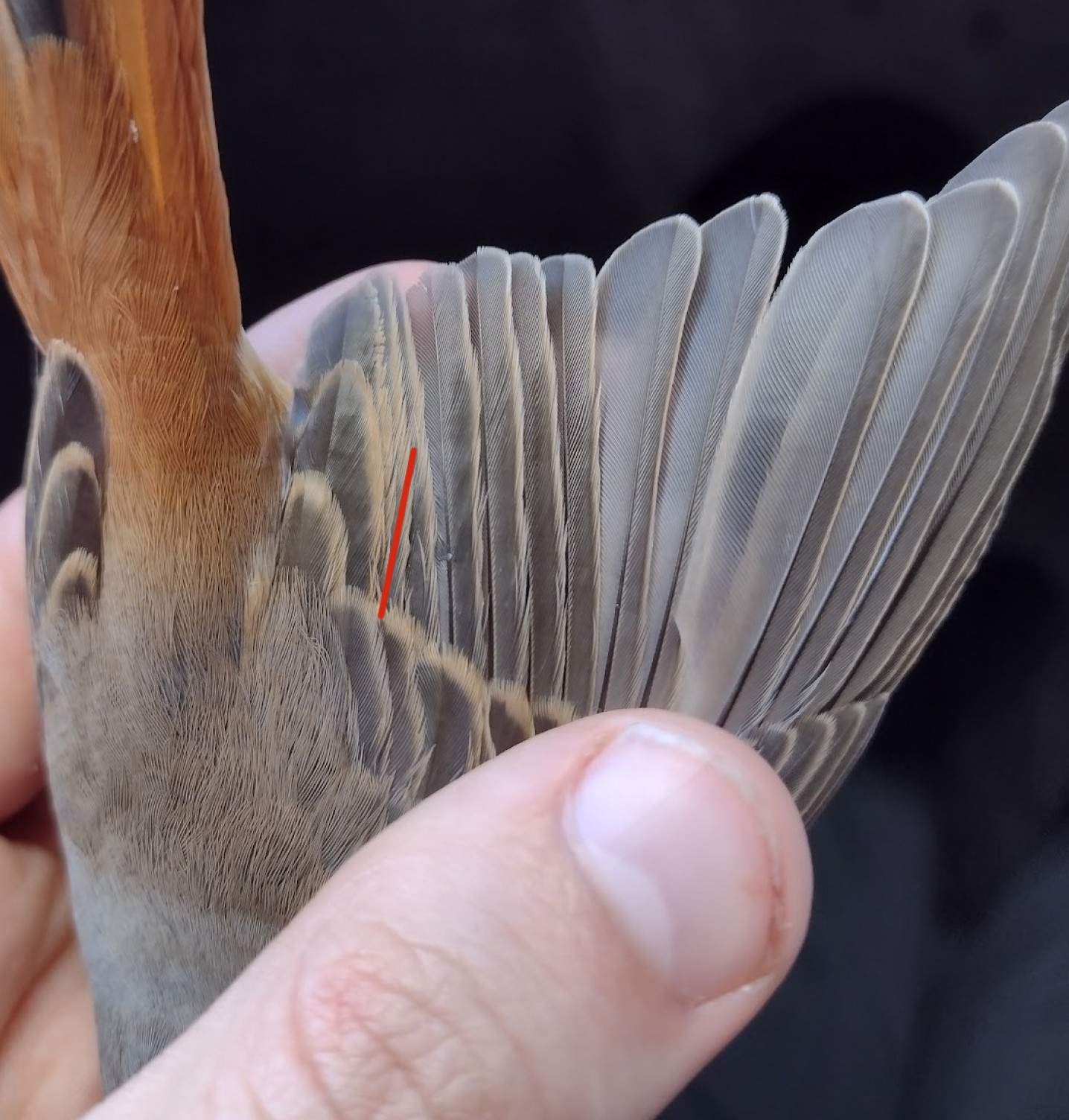
Wing of a 1k female Common Redstart. The red line points to the moult limit in the greater coverts, where the outer feathers, with brown base-colour and buffish edges, are juvenile-type, while the two inner feathers, with a more grayish base and edges, are adult-type. In an adult (2k+) bird, all of the greater coverts would be of the adult-type. Foto: Alba M. Holmberg, taken 25/8 2026.
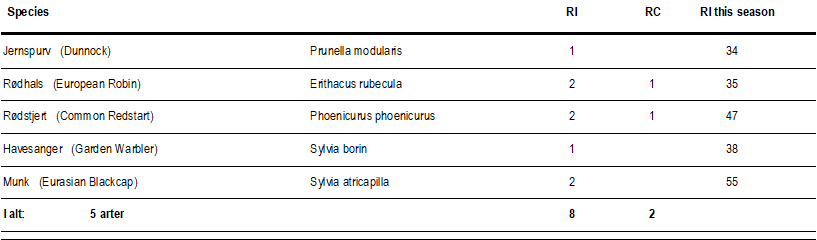
At the station: Johan, Strummer, Alba