
Her på Blåvand's blog bringes korte nyheder i dagbogsformat om livet og hændelser på fuglestationen.
-
FORSIDE

- Blog
Adult Robin go brrrr
onsdag 16. september 2026
Observations:
Ringing:
Today we had two guests who joined ringing for part of the morning, and obs for another part. Unfortunately, we only caught a few birds to show them (12 throughout the whole morning), but few birds also meant that I had time to show and explain some of the characteristics we use to age the birds. In this respect, the morning started out rather spectacularly, with the season's second adult Robin (Erithica rubecula) being the very first bird ringed.
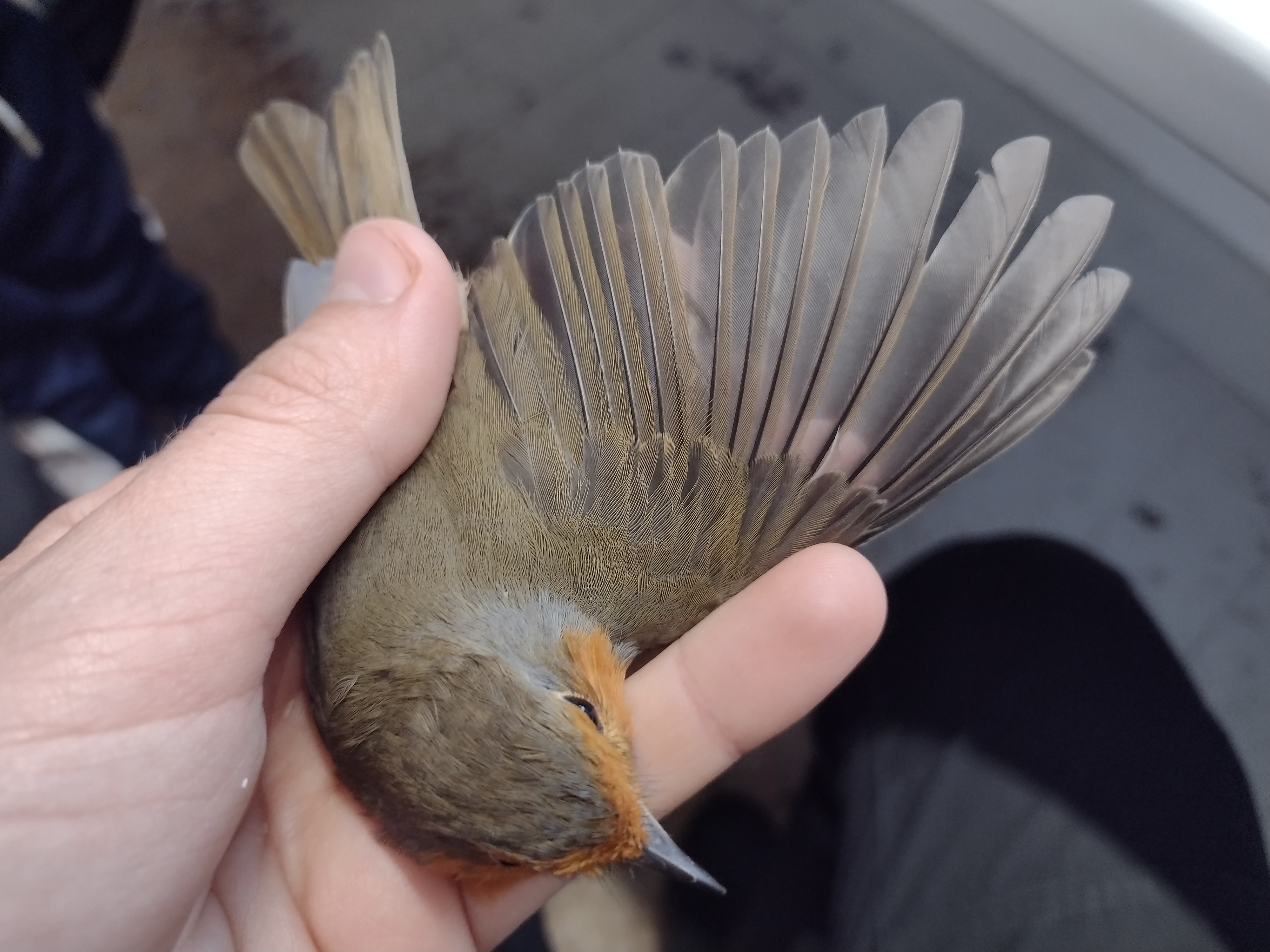
Wing of an adult (2k+) Robin. Note that, although a few of the greater coverts have some light spots, those spots are very small and dark-buffish compared to the typical spots on juvenile-type feathers, and that there is no shift in the base colours of the feathers, meaning that there is no moult contrast. This, combined with very rounded tail feathers, reveals it to be an adult individual. Foto: Alba M. Holmberg
The very last bird of the day was another welcome surprise: The fourth Blue Tit (Cyanistes caeruleus) of the season. As per usual Blue Tit fashion, it was an angry little ball of feathers with a tiny but strong beak that it used to tirelessly peck at me whenever it got the chance. Because of this, getting a good picture was a bit of a challenge, but we managed in between its hacking-barages on my fingers.
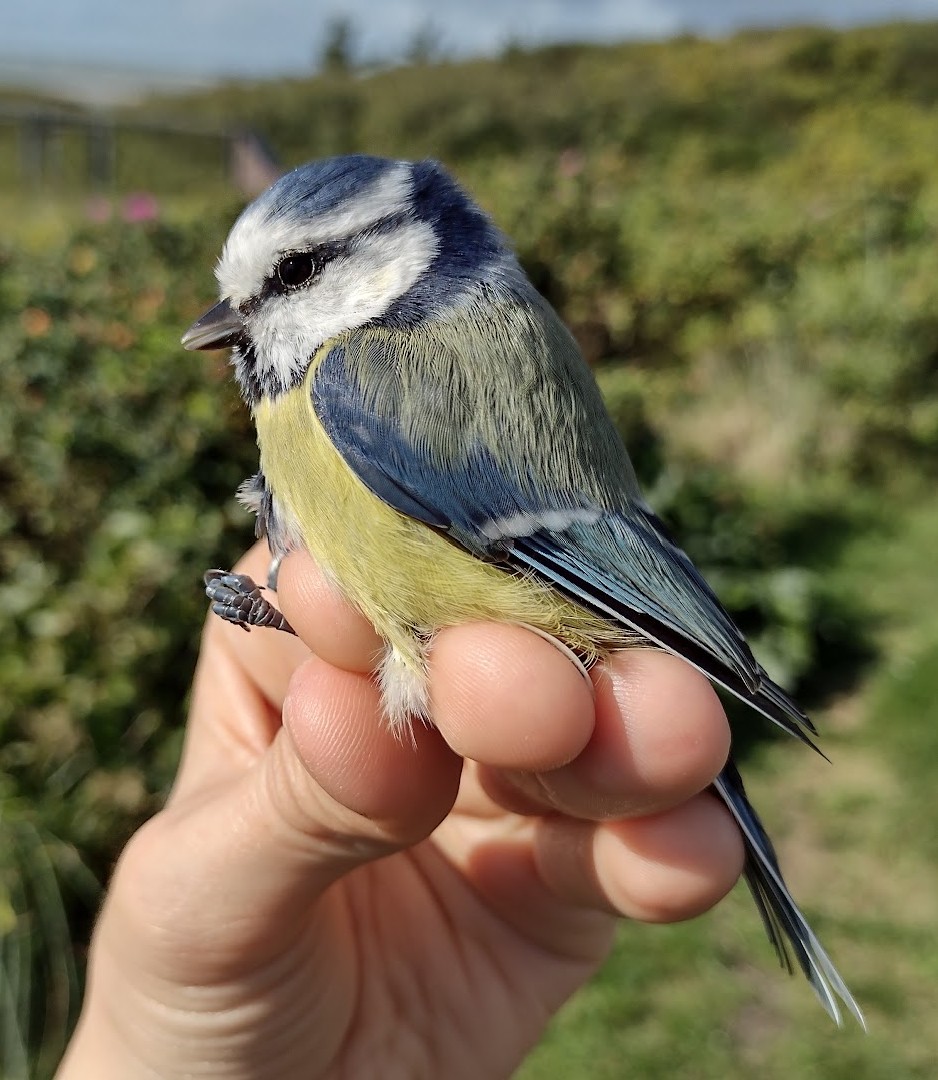
A young (1k) Blue Tit. The combination of a broad dark-blue neckband and very striking blue colours (seen better in person) indicates it to be a male. Foto: Alba M. Holmberg
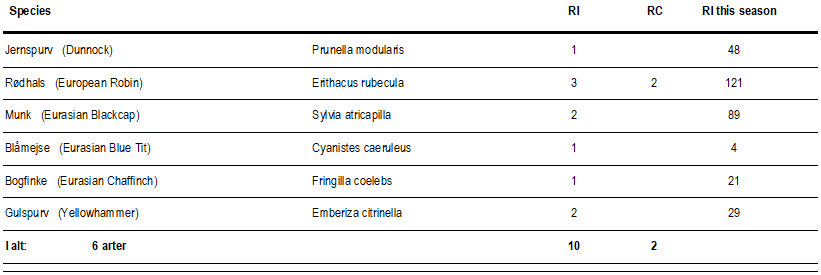
Today's captures:
At the station: Strummer, Alba
Back to slow ringing
tirsdag 15. september 2026
Observations:
Ringing:
I'm starting to sense something of a pattern with the good ringing days immediately being followed up by pretty bad days. As yesterday was among the best days of the season, it must thus come as no surprise that today was pretty boring by comparison, with not even 20 birds being caught. This probably owes in great part to the fact that a constant light and foggy precipitation throughout the morning and day had reduced visibility to less than five kilometers, and (in my experience) birds tend to be less active during such conditions.
Robins (Erithacus rubecula) still make out bulk of the captures, today with 8 individuals out of the total 18, but as they in general are very nice birds to work with, I have no complaints about that. With so many birds of one species being caught, it's fun to compare and contrast especially variable traits among individuals, such as, in robins, the size and colour of the light dots at the tips of the primary coverts. Now, most Robins have juvenile-type greater coverts rather large, whitish-buff tips on them, while most of the time, the adult-type coverts lack any such spots. However, there are many exceptions to this rule, with the juvenile feathers of some Robins lacking the spots entirely, and some adult feathers having (usually smaller and darker coloured) spots. A less extreme example of the last type of exception is shown in the picture below:
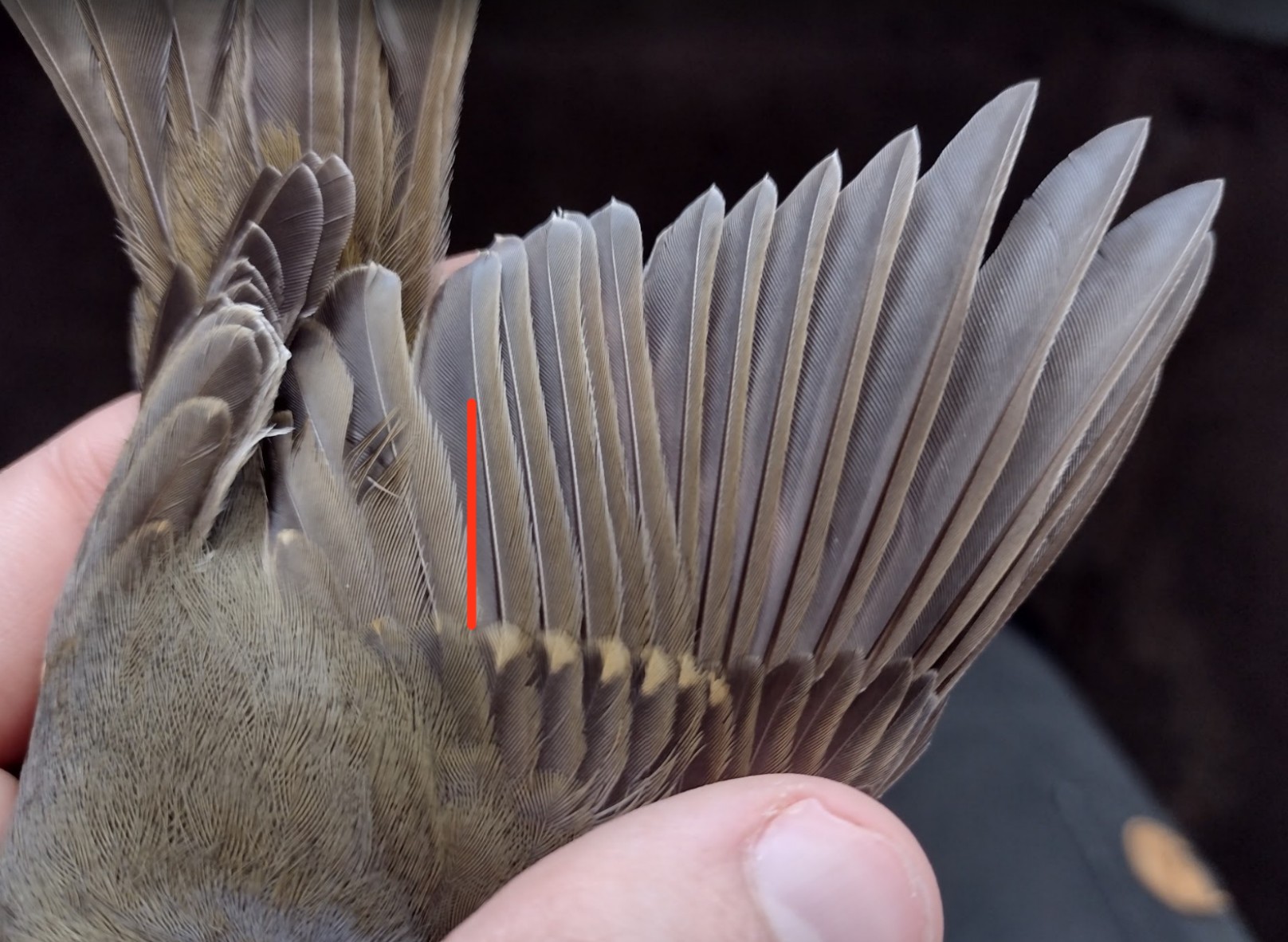
Wing of a 1k Robin, with the red line showing the moult limit between the juvenile-type outer greater coverts with big light spots on the tips, and the adult-type inner greater coverts, with small, more dark-buffish tips. Foto: Alba M. Holmberg.
Because of these complications, it is always important to, in addition to any change in the spotting of the greater coverts, also establish that there is a difference of base colours between the two generations of feathers before declaring a moult limit to be present (in Robins).
Today's captures:
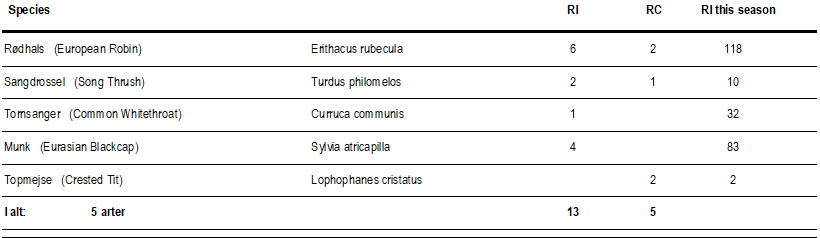
At the station: Strummer, Alba, Johan, Emil?
Robin invasion in the early hours
mandag 14. september 2026
After the fiasco that was ringing yesterday, it could (almost) only get better today, and with mild northwestern winds and no rain on the forecast, it looked like it would. After having opened most of the nets in both the Station and Lighthouse gardens, I realized we might get a quite busy day when I caught a whole three Robins (Erithacus rubecula) in just the Station garden on the very first round (its usually a very good sign if we catch as many as two), and after having caught another 9 Robins and a Tree Pipit (Anthus trivialis) in the Lighthouse garden on that same run, I realized I had to call Strummer back from obs to help me out.
The Robin invasion slowed down considerably, however, after that first round, but we still caught good numbers of them throughout the rest of the day, as well as fewer numbers of a good range of other species, landing us on a species total of 15 different species. The Robins, with 34 individuals caught, only one of which was a recap, contributed with more than half of all of the 62 birds caught today, with Willow Warblers (Phylloscopus trochilus) ranking second with (only) 5 individuals.
The second coolest bird we got today is one I sadly don't have any pictures of, since it was the very first bird of the day, meaning I was too busy to take any. This was the very first, and currently only, adult (2k+) Robin of the season, which could be distinguished from its younger species-mates by its rounder tail-feathers as well as greater coverts lacking any sort of moult limit, instead all being of the olive-green adult feather type.
The undisputed coolest bird of the day was caught in our least-successful capture-contraption: The Helgoland Trap. To trap birds in the Helgoland trap, we usually clap and whistle to try to scare any birds in the big part of the trap down into the small box at the end of the tract-like ruse. This bird, however, had found its own way into the box, and had I not heard it flapping from outside and closed the box off, it might have flown out and escaped as I exited the trap. Luckily I did hear it, and when I checked to see what had ventured into the box, I saw that is was an eagerly awaited catch. It was a Northern Wheatear (Oenanthe oenanthe)!
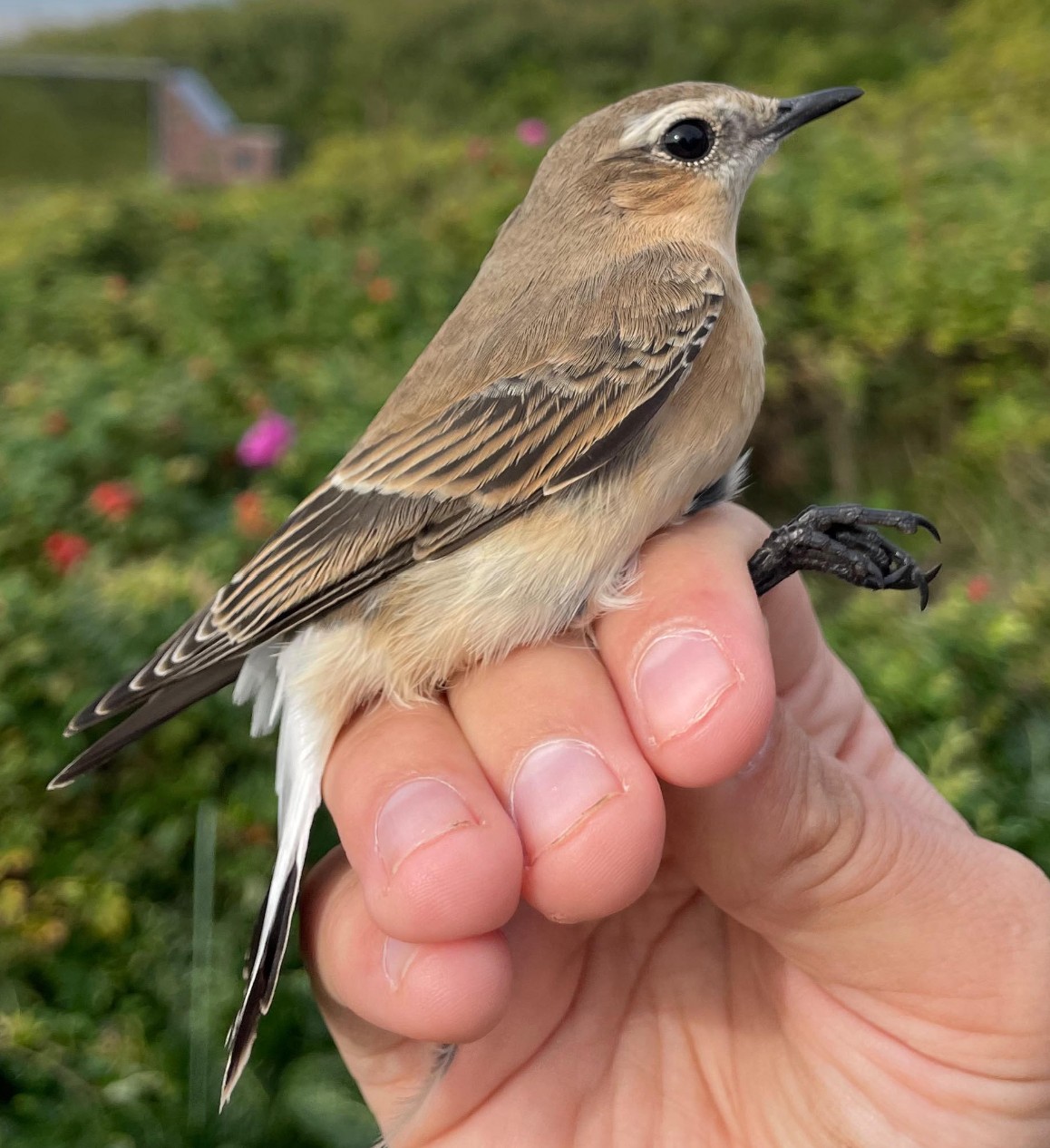
Northern Wheatear, a first for the season! Foto: Strummer Edwards
Since Strummer and I have both been very eager to catch one, I called them up to the Lighthouse where they got to see it just after I had finished processing it, so we could both get some good pictures before letting it go.
After having had Station nets open for some time after standard was over, we also managed to replace some of the nets in the garden that needed it most, so hopefully these nets will catch more in the upcoming time.
Today's captures:
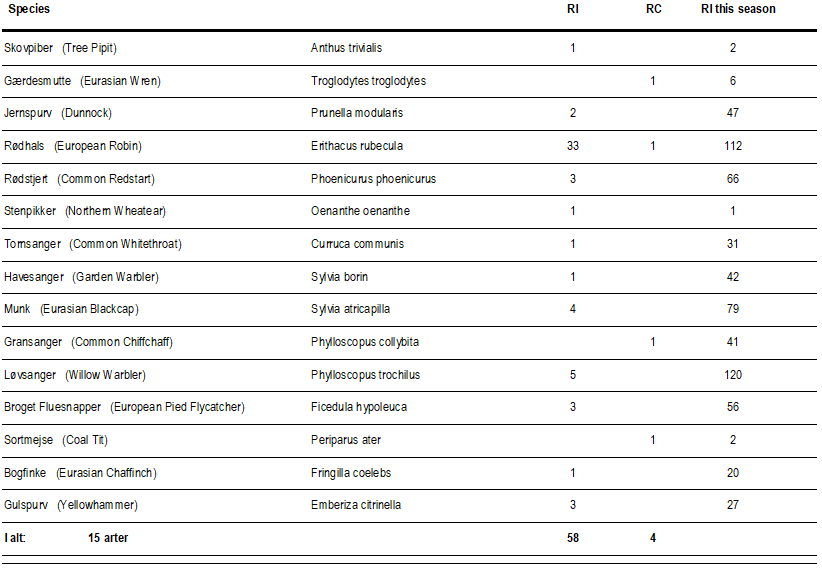
At the station: Strummer, Alba, Johan, Emil
The calm after the storm
søndag 13. september 2026
Observations:
Ringing:
After the high that was yesterday, I should have predicted the low that was to come today, given our previous (lack of) luck this season. But alas, it was with an optimistic heart that I set out to open the nets this morning, hoping for a fun, slightly busy day split between the two gardens. Not even an hour (and not even 5 birds) went by before Strummer warned me about some ominous-looking clouds headed in our direction, and although DMI's radar didn't show any such precipitation, blindly trusting that piece of technology has come back to bite us before, so I decided to play it safe and only have the Station Garden open.
Although the clouds indeed did not bring much more than a very light drizzle (not enough to close the nets, but just enough to go rounds more frequently), the rest of standard time only brought 3 additional catches, as well as an almost-catch in the form of a Sparrowhawk that escaped just as I was running toward it. Thus, we ended with a total of 7 birds caught, all of them new, of which the bulk was young Robins (Erithacus rubecula) (3 individuals) and the next most common bird was the Common Chiffchaff (Phylloscopus collybita) (2 individuals).
The very last bird of the day, a Dunnock (Prunella modularis), was a bit unusual though. When taking it out of the bag, I threw a cursory glance at its tail, and seeing some pretty broad and rounded retrices (tail-feathers), I expected it to be an adult (2k+), but when looking at its wing to properly age it, it looked to be a young (1k) bird. After taking a proper look at its tail though, I realized what was going on.
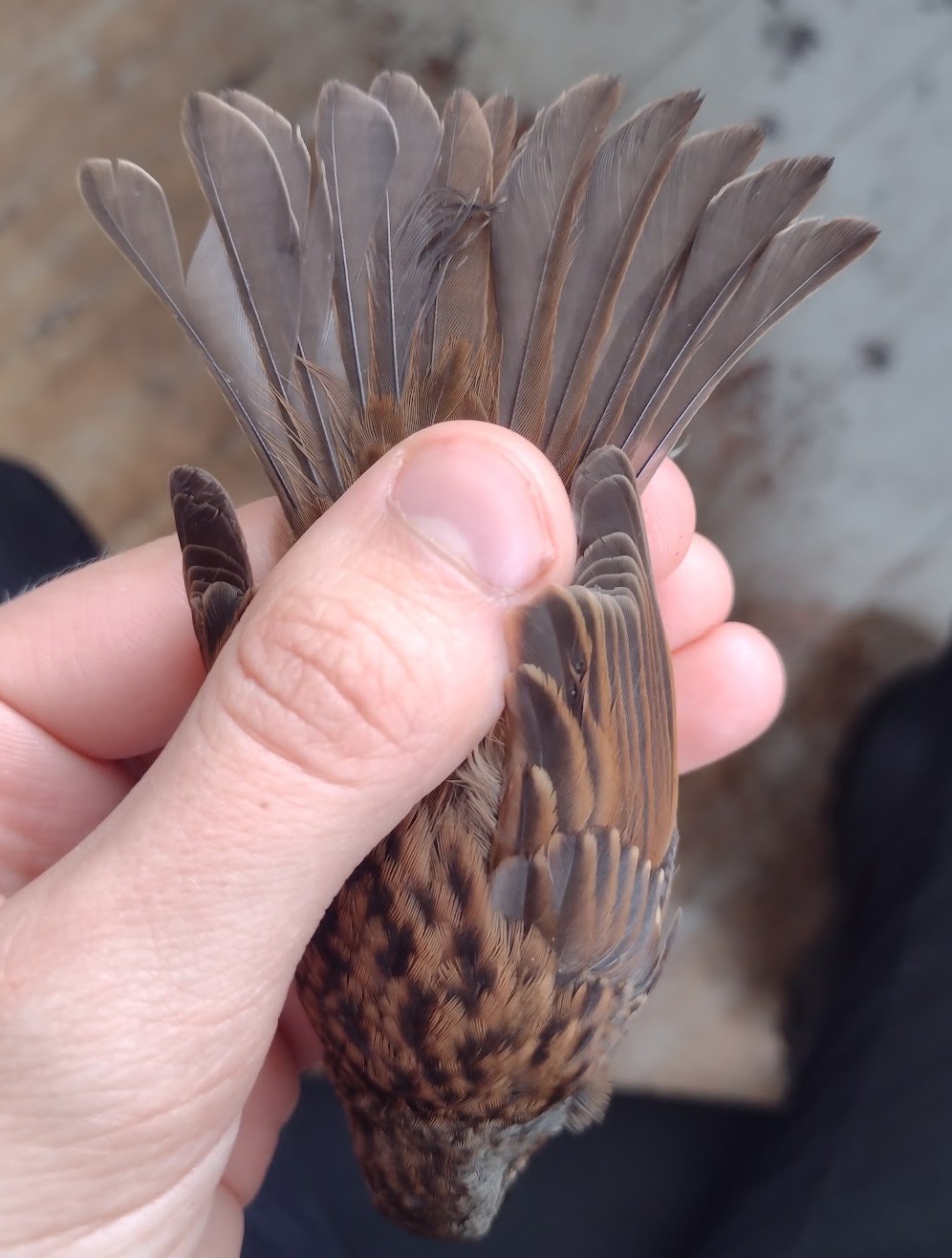
Tail of the Dunnock. Foto: Alba M. Holmberg
It had lost at replaced half of its tail!! On the picture above, it can be seen that half of the tail (the right half as seen from above) consists of feathers with quite narrow and sharp ends, as well as a more brownish ground colour, while the other (left) half has broad feathers with rounded ends, sporting a more uniform grey-ish colour. The sharp tail-feathers are textbook juvenile tail-feathers, while the rounded ones are typical of adult Dunnocks, so why does this bird have both types? The answer is quite simple: It must have lost half of its (juvenile-type) tail and then regrown the lost retrices as adult-type feathers!
This is one of the reasons that it is very dangerous to age a bird as being adult based only on the tail, as it could concievably have lost its whole tail at some point and then regrown it with adult-type feathers.
Another thing ringers look for in the tail-feathers when trying to age a bird is so-called growth bars, which are bands on the feathers of poorer quality than the rest of the feather originating from times where the bird did not get much to eat during the growth of the feather. For juvenile-type tails, these bands will usually allign pretty well with each other across the feathers of the whole tail, as juvenile birds typically grow out their whole tail at the same time. When adult birds moult their tails, however, they usually do that one pair of feathers at a time, so the tail is replaced in increments instead of all at once. Since not all of the tail-feathers grow out at once, any growth-bars will usually not allign across the whole tail. Thus, if the bars allign, its probably a young bird, and if not, its probably an adult. However, in the event of the tail getting lost when not in the context of moulting, all of the feathers can grow out simultaneously, even in adult birds, so there are exceptions to this rule.
Though it is difficult to see on the picture, it looks as if the adult-type half of the Dunnock's tail has growth-bars that line up pretty well with each other, indicating that the whole half of its tail was lost at once, maybe to something like a Sparrowhawk grabbing onto it.
Today's ringing totals:
Jernspurv (Dunnock): 1
Rødhals (European Robin): 3
Gransanger (Common Chiffchaff): 2
Løvsanger (Willow Warbler): 1
At the station: Strummer, Alba, Johan, Emil
Sparrowhawk and friends
lørdag 12. september 2026
Ringing
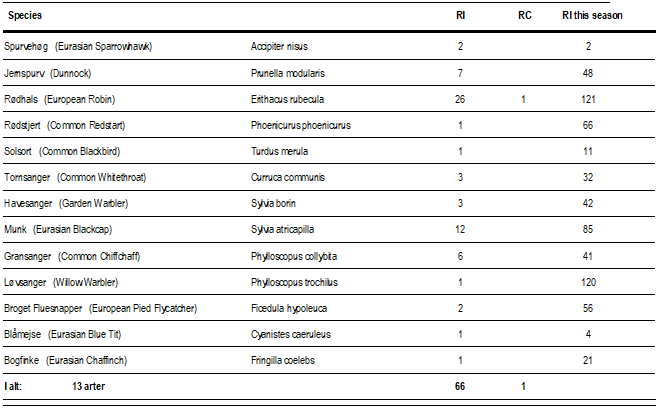
After many slow days of ringing, our luck finally seemed to break. In the lighthouse, I had over 15 birds in just the second round, by far our best single round of the season, and Alba had 8 and 5 during the first two runs in the station. What followed was a consistent stream of birds, with about five per round in the fyrhaven.
Robins (Rødhals) were the primary bulk of the day with 26 caught (still all 1Ks unfortunately) but we also had a good deal of Dunnock (Jernspurv) and Chiffchaff (Gransanger).
After the early rounds started to slow down, I took a minute to open the krat, hoping to catch something interesting. Sparrowhawks (Spurvehøg) and Jays (Skovskade) were flying around the area so I was hoping we'd get lucky and catch one of the long awaited season firsts. After a few rounds of 1-3 birds, I was heading over the hill to check krat when I saw a large bird caught at the far end of the long net. I threw down my net stick and sprinted to catch it, luckily making it before the bird was able to escape. I extracted it and brought it down to the station so we could give it a steel ring and make sure everyone saw it. A quick look at the wing length and plumage characteristics easily identified the bird as a first cycle male, leaving plenty of time for pictures before we continued ringing.
Just one hour later, I was in almost the exact same spot on the hill down to the krat when I saw a second sparrowhawk stuck, making for a lovely suprise! Alba was able to ring this bird and we did a quick demonstration for a group of families already at the nature center.
We ended the day with 66 new birds and one recapture, by far our best day of the season.
Fun day at obs
fredag 11. september 2026
Observations
With no ringing today, Johan and I bravely trekked to the observation post for what we hoped would be a nice morning of birding. With strong southwestern winds, we were hopeful we would have good luck with migrating passerines and anything else Blåvand would give us. Thankfully we were rewarded with a remarkeable morning of observations.
Throughout the day, we experienced a steady stream of southbound Common Scoters (Sortand), cummulating in the best count we have had all season with 941! There were other waterbirds throughout the day, including a season first Red-necked Grebe (Gråstrubet Lappedykker), notably only the second I've ever seen after I got my lifer at Blåvand in 2023. We also had a close flyby of Pintail (Spidsand) which was a welcome highlight when obs was in a bit of a lull.
For passerines, it was a wonderful day of movement. Throughout the later morning, we were getting frequent flyovers of Meadow Pipits (Engpiber), ending the morning with over 200!!! We also had individual flyovers of White Wagtails (Hvid Vipstjert) and Sparrowhawk (Spurvehøg).
People at the station: Strummer, Johan, Alba
Redstarts on the move (some with colour-mutations)
torsdag 10. september 2026
My day started out with me falling down the stairs of the bird station and lightly stunning a finger on my (thankfully non-dominant) left hand. With my luck for the day seemingly firmly established, as well as initial strong north-western winds, I had very low hopes for the ringing, which I was honestly fine with if it meant I could give my injured finger a bit of rest. During the first few rounds at the Lighthouse garden, I did, however, get decent ammounts of birds considering the few nets I had open, and my finger, though hurting a bit if strained too much, turned out to not be too much trouble and I could handle the birds almost as easily as normal.
After winds had died a bit down, and more nets had been opened, I started to get some slightly busy rounds, with Common Redtstarts (Phoenicurus phoenicurus) and European Robin (Erithacus rubecula) clearly dominating the numbers. It was down at the non-standard nets at Krattet that I caught the bird of the day: A young male Redstart with a few pure-white feathers on its crown; it was partially leucistic!!

Young male Common Redstart with some pure-white feathers on his crown, revealing him to be partially leucistic. Foto: Alba M. Holmberg
With the ringing spotlight of the day being established as a male Redstart, I might as well demonstrate how we age them. First off, young (1k) males at this time of year generally have very ill-defined black throats, while the adults (2k+) usually have more obvious black throats, even if the black is hidden slightly by white edges to the feathers. But to be completely sure of the ageing, we look at the wing-feathers, particularly the greater coverts. Below is a picture of the same Redstart, showing off his wing-feathers:

Looking at the wing of the Redstart reveals a clear moult-limit in the greater coverts between the inner adult-type gray feathers, and the outer juvenile-type brown feathers. Foto: Alba M. Holmberg
Notice how the innermost greater coverts are edged gray, while the outer ones have dark-brown centres with buff edges. This is because the outer feathers are of juvenile type, which it grew before leaving the nest, while the innermost greater coverts have been replaced by adult-type feathers during the bird's partial post-juvenile moult. Adult Redstarts at this time of year will have undergone a complete post-breeding moult, where they change all of their feathers, so on such a bird, this type of moult-limit would not be found.
After standard was over, we kept the Station Garden open for a few hours more, and in total, we managed to catch 51 birds throughout the day, distributed over 46 new birds and 5 recaptures. Not a bad day at all.

At the station: Strummer, Alba, Johan
What to say?
onsdag 9. september 2026
Another day with northwesterlies spells boring observations. I am getting quite used to the very slow mornings. I get to practice my humming, cloud recognition and general patience, and sometimes theres even birds! The few there were today didn't blow me away. A Gray Heron (Ardea cinerea) came by and got bullied quite bad by some hybrid crows which served as some entertainment. Other than that the time was passed by aging Northern Gannet (Morus Bassanus) and waiting for the morning coffee.
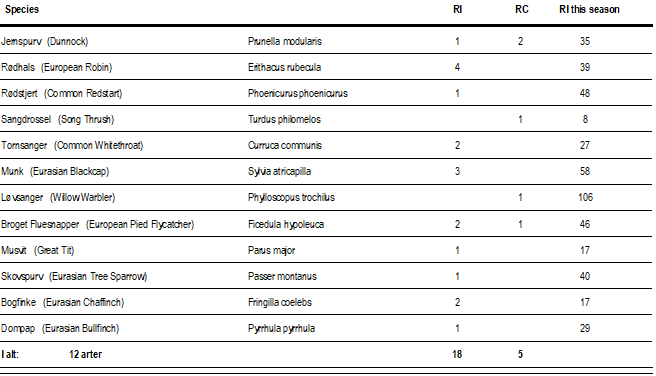
Ringing was decent if you put it up against recent days. 23 birds were caught with 8 of them being caught in the last run of the station. Catches were distributed over 12 species giving a nice diversity with some always cool Dunnocks (Prunella modularis), European Pied Flycatchers (Ficedula hypoleuca) and a beautiful adult Eurasian Blackcap (Sylvia atricapilla) that Strummer could enjoy.
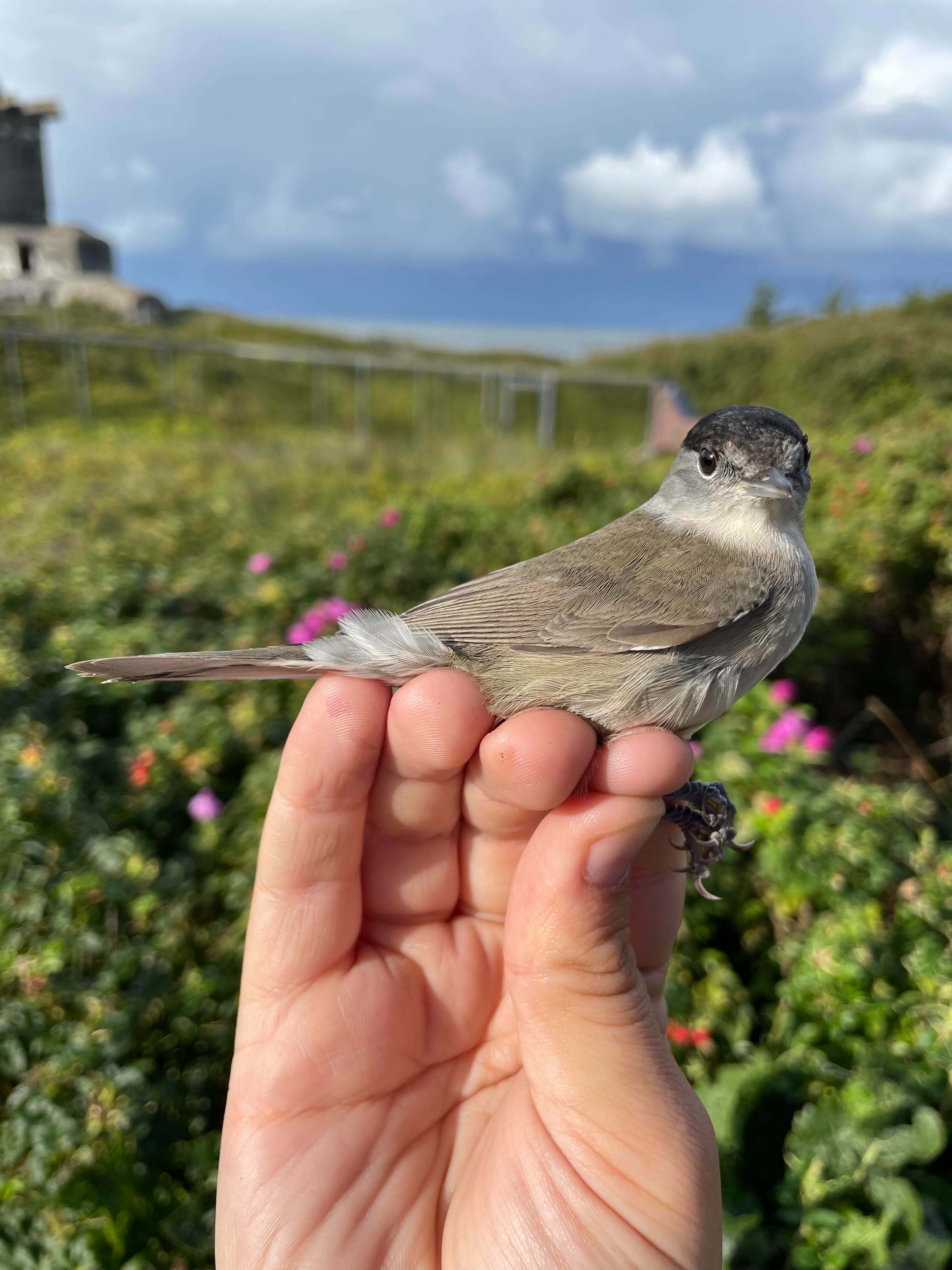
Strummer holding the Eurasian Blackcap (Sylvia Atricapilla) responsible for saving their day. Photo: Strummer Edwards
Todays ringing numbers:
At the station: Strummer, Alba, Johan
Lots of Sparrows
tirsdag 8. september 2026
Observations:
Today on obs was another decent day. Johan spent his first day at the September observation point where he had multiple Sparrowhawks (Spurvhøg) and a Gray Heron (Fiskehejre). He also had a single 4k+ Gannet (Sule) which gave good looks.
Ringing
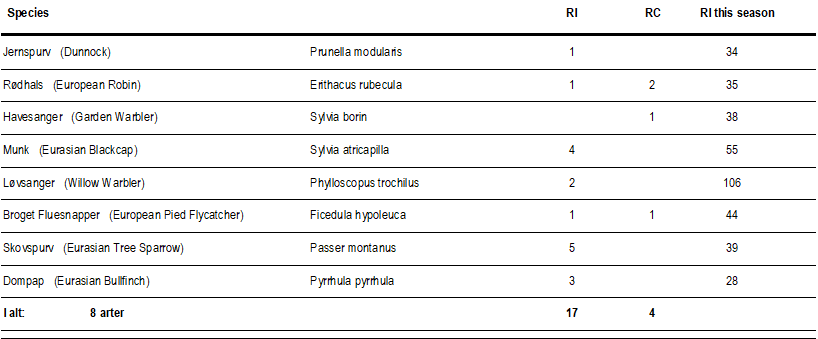
Ringing today was a similarly slow experience. We ended the day with 21 birds (17 new, 4 recaptured), with the station being marginally more producting than the lighthouse. Bulk today were five Tree Sparrow (Skovspurv), which was very nice as we haven't caught too many of them this season. In the areas they were caught, it was concentrated along where we have been actively clearing out the rose bushes, so hopefully they came into the net as a result of that!
We also had a few migrants, including 4 Blackcap (Munk), and Willow Warblers (Løvsanger). Every time we checked the radar it seemed like rain would come in an hour but thankfully we narrowly avoided it each time.
After we closed, I spent a while continuing to clear the rose bushes in the station, making a few deep cuts inbetween the first station net and the long net.
Today's captures:
People at the station: Johan, Alba, Strummer
Time to tune in to some calls
mandag 7. september 2026
Observations:
A good day with southern winds brought some passerines. I hit the hole and was joined by Bent throughout the morning obs which was a nice addition to the nice weather. Sadly he missed a Peregrine Falcon (Falco peregrinus) hitting me right in the head within the first hour :/. Other than that miss, we had a lot of decent birds together for the rest of the morning. This included a nice migration of Meadow Pipits (Anthus pratensis) where we had 295 in total, 5 Eurasian Collared-Doves (Streptopelia decaocto), and 2 Great Egrets migrating over the ocean. A general good day with an array of different species and good company
Ringing:
Today initially looked promising, with manageable winds coming straight form the south and our weather-apps promising no rain within standard hours. That promise was broken, however, when approximately an hour into standard, a good-sized raincloud was set to move over us. Because of this, we had to close the nets for more than an hour, thus ruining our standard-run of ringing. After the rain had passed, we opened the nets yet again in hopes that we migth enjoy some of the passerine-migration that Johan was seeing, but alas we had little luck, and with only a few birds caught per round, if any at all.
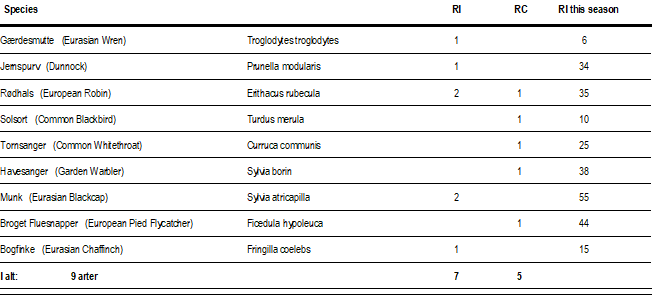
Although it wasn't a great day numbers-wise, with only 12 captured birds of which 7 were new and 5 were recaps, we still did catch some nice birds. One of the highlights for me was a recapture of a very pretty male Blackbird (Turdus merula), which we caught while Johan was walking with me after returning from obs, and who made a very pedagogical example of how to age young Blackbirds.
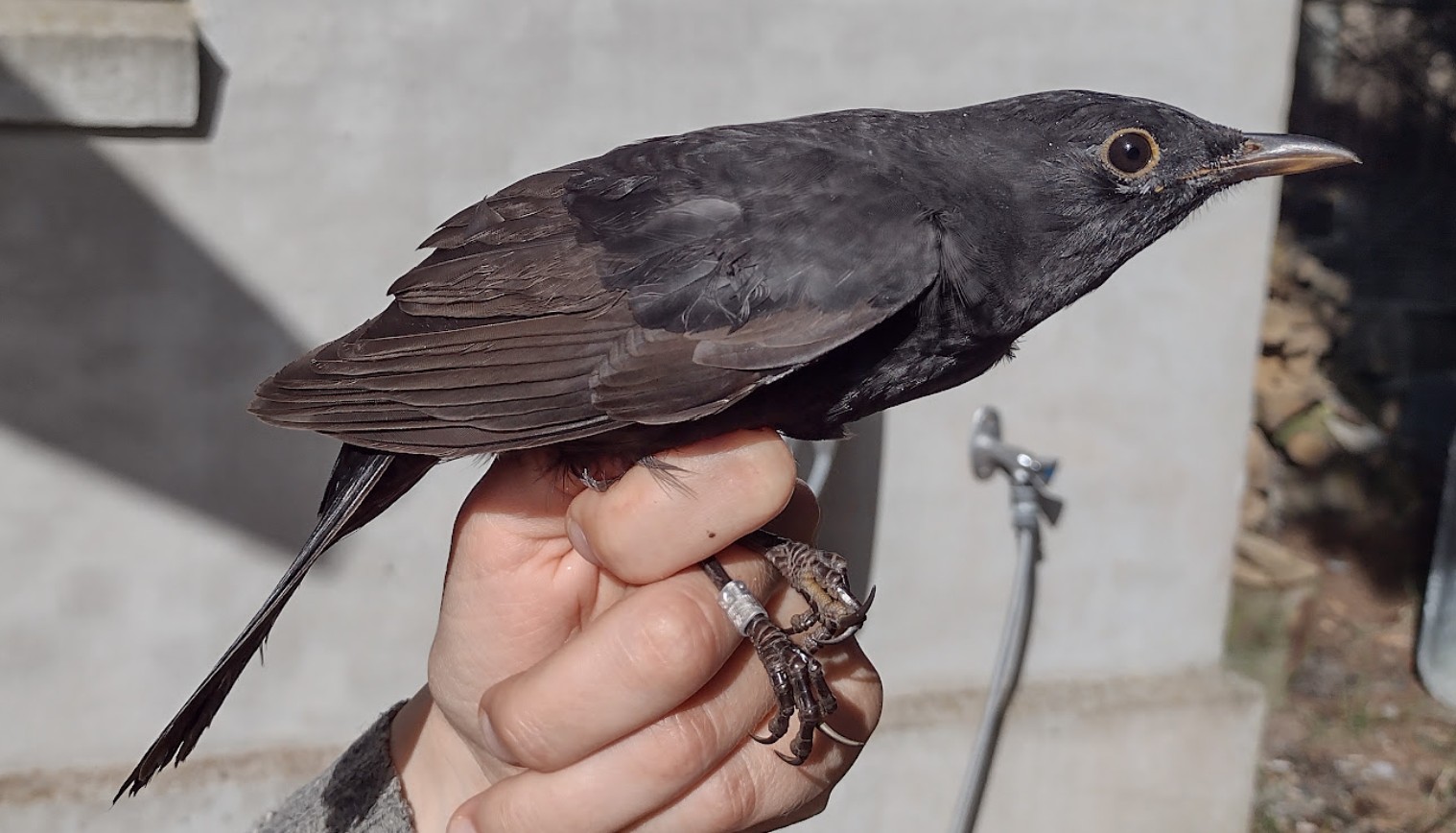
Recap of a Blackbird. The black feathers on the body, head and some of the wing reveal it to be a male, and the juveline-type brown flight feathers on the wing, contrasting sharply with the adult-type black feathers, as well as the overwhelmingly black beak and very weak orange eye ring, all point to it being a young 1K bird that has undergone its partial postjuvenile moult. Foto: Johan Them Steffensen
Another highlight was the very last bird of the day, a beautiful Chaffinch (Fringilla coelebs):
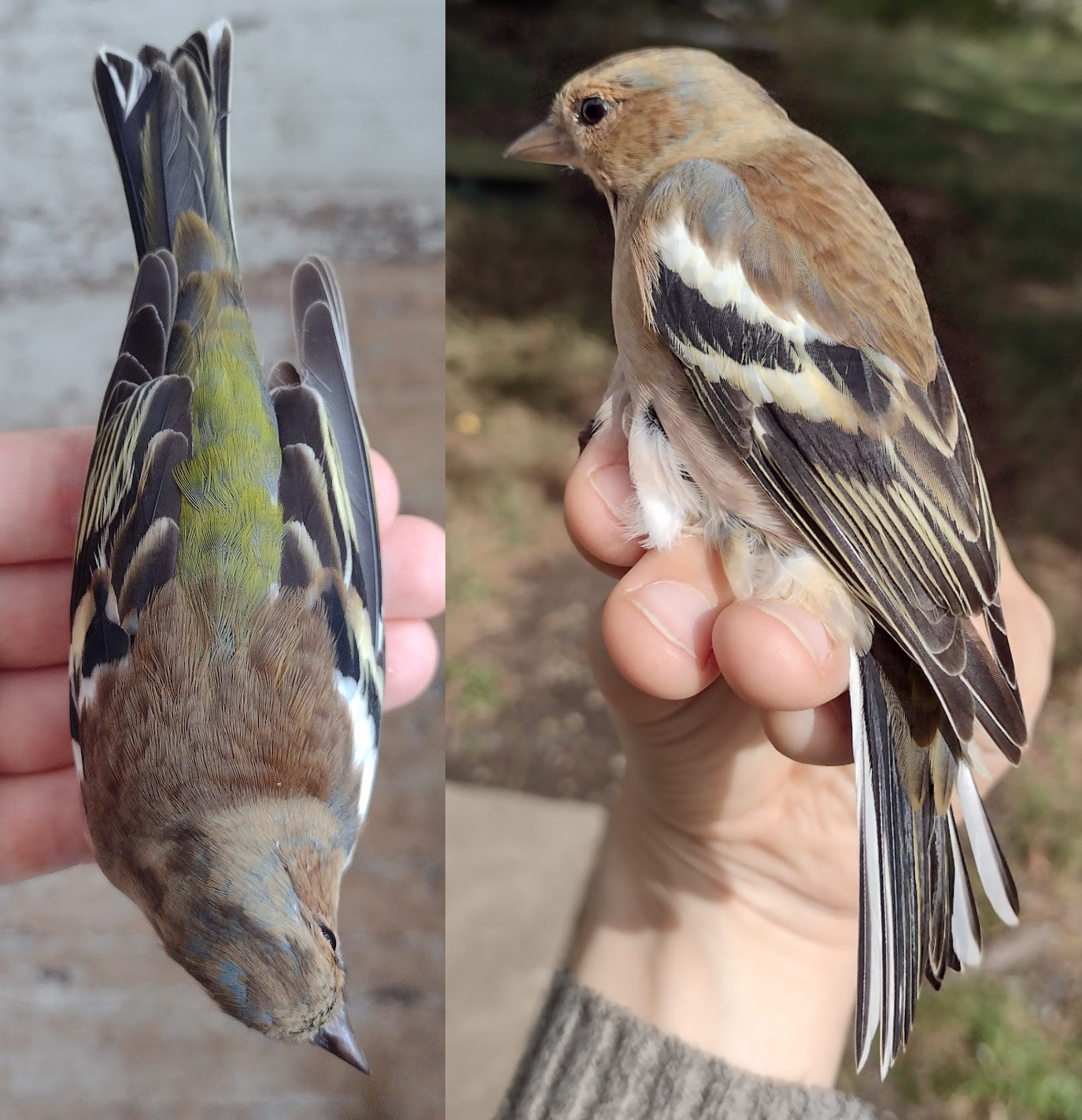
Chaffinch male in winter plumage. Although not as colourful as when in breeding plumage, the male can still be distinguished from the female by the traces of blue on the head and wrists, as well as the pinkish hue on the chest, as opposed to females that are wholly nuances of brown. Foto: Alba M. Holmberg.
Today's captures:
At the station: Johan, Strummer, Alba, Bent